HOGG ISLANDBOA
Boa imperator · Family Boidae
KEY TAKEAWAYS
The Hogg Island boa is a dwarf, pale-colored boa that lives only on the Cayos Cochinos, a small island group off the north coast of Honduras. It is an island population of the Central American boa (Boa imperator), not a separate species, and it is not venomous.
- It is harmless to people. Like every boa it has no venom and kills prey by constriction.
- Wild adults are small for a boa: females average about 3.7-3.9 ft (113-120 cm) from snout to vent, males about 3.2 ft (96-99 cm).
- Collectors took an estimated 5,000 to 15,000 snakes from the islands between 1979 and 2004, and for a time the boa was rumored to be extinct in the wild.
- Researchers estimate fewer than 3,000 live in the wild today, on just two islands with about 0.9 square miles (2.2 km2) of land.
Hogg Island boa quick facts
| Common name | Hogg Island boa, Hog Island boa, Cayos Cochinos boa |
|---|---|
| Scientific name | Boa imperator Daudin, 1803 (island population); formerly Boa constrictor imperator |
| Family | Boidae (boas) |
| Venomous | No, a constrictor |
| Adult length | Mean snout-vent length about 3.2 ft (96-99 cm) in males and 3.7-3.9 ft (113-120 cm) in females; females usually 5-6 ft (1.5-1.8 m) in total length |
| Weight | Mean 0.9-1 lb (399-434 g) in males and 1.7-2.6 lb (759-1,202 g) in females |
| Range | Cayo Cochino Grande and Cayo Cochino Pequeno, Cayos Cochinos, Bay Islands, Honduras |
| Habitat | Oak forest and sea grape scrub, mostly in trees under dense canopy |
| Diet | Lizards, birds, bats and, on Cayo Cochino Grande, small to medium mammals |
| Reproduction | Live-bearing; young born August-September; one recorded wild litter of 5 |
| Wild population | Fewer than 3,000 (2015 estimate) |
| Conservation | CITES Appendix II; collection and export banned by Honduras; protected inside the Cayos Cochinos Natural Marine Monument |
How to identify a Hogg Island boa
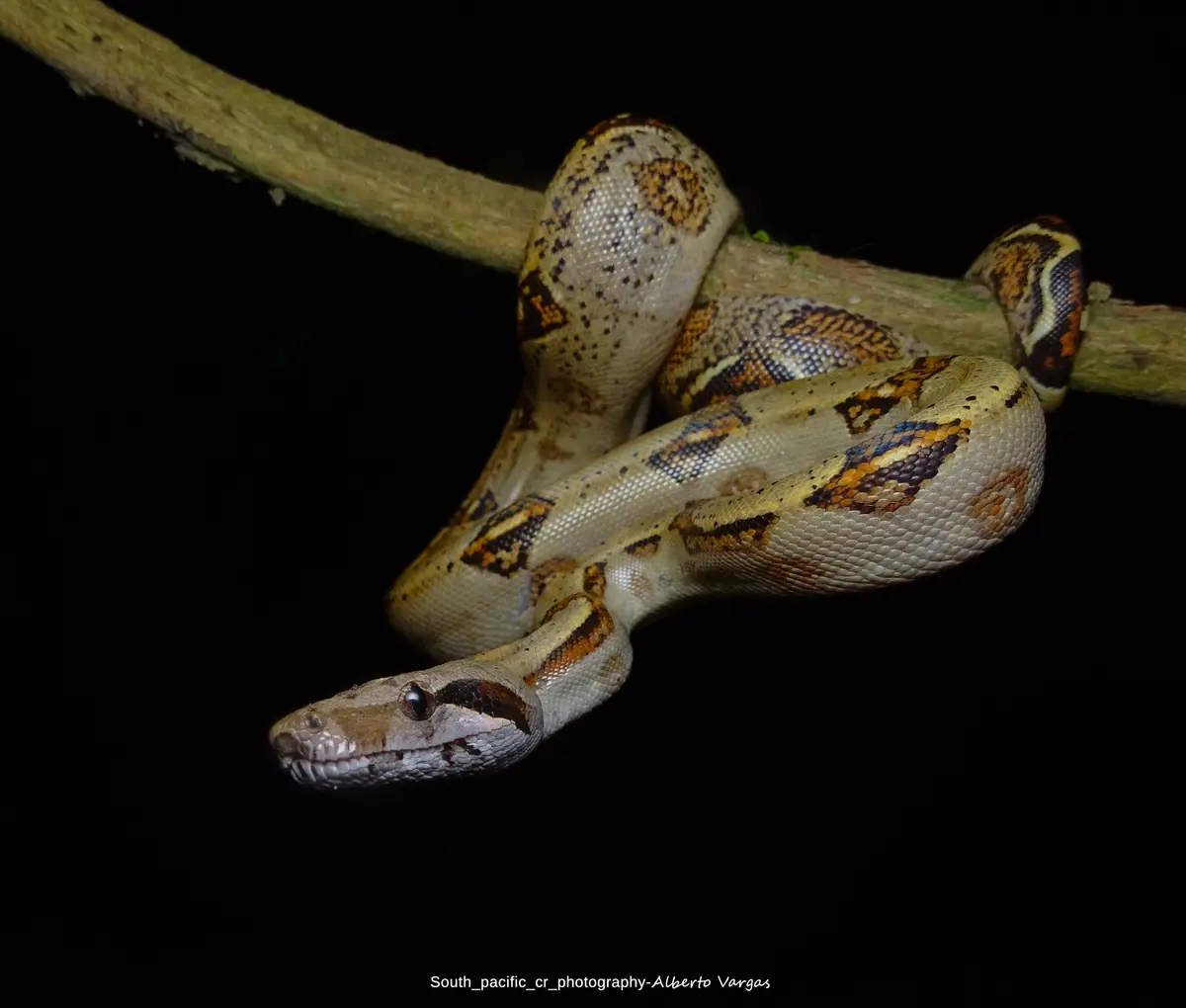
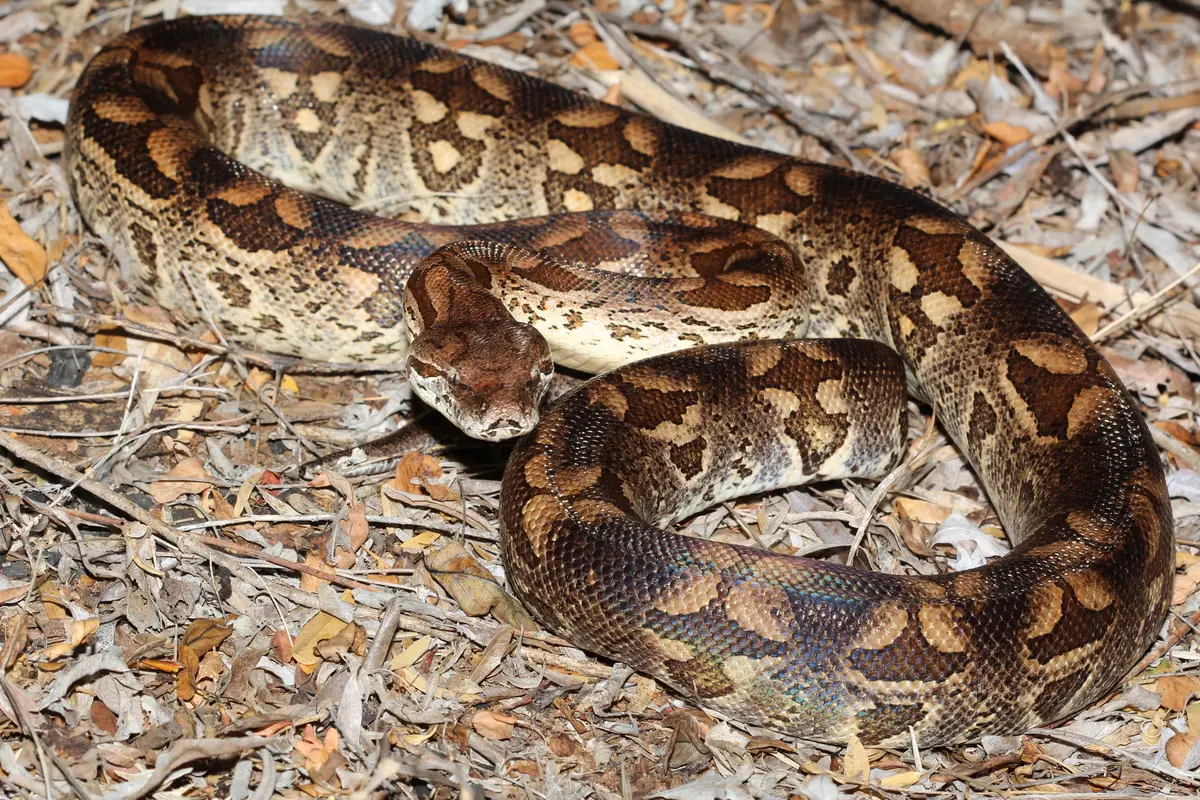
A Hogg Island boa looks like a faded, small boa constrictor. The pattern is the familiar one, with dark-edged saddles along the back, but the ground color is pale gray to pinkish and the dark pigment is reduced. Keepers call this look hypomelanistic. The CITES case study by Montgomery and colleagues notes that the pet trade prizes these boas for their light pink back and their small size.
- 1Pale body color: a light gray, cream or pinkish background with soft tan or brown saddles, much less contrast than a mainland boa.
- 2Boa saddles and tail: the usual boa pattern of saddles that widen toward the tail, where they turn reddish or orange.
- 3Small adult size: adults are about half the length of big mainland females. A snake over 6 ft (1.8 m) on the islands would be unusual.
- 4Stripe through the eye: a dark stripe runs from the snout through the eye, as in other boa constrictors.
- 5Heavy, slow-moving body: a thick, muscular snake with small smooth scales on the head and tiny spurs beside the vent.
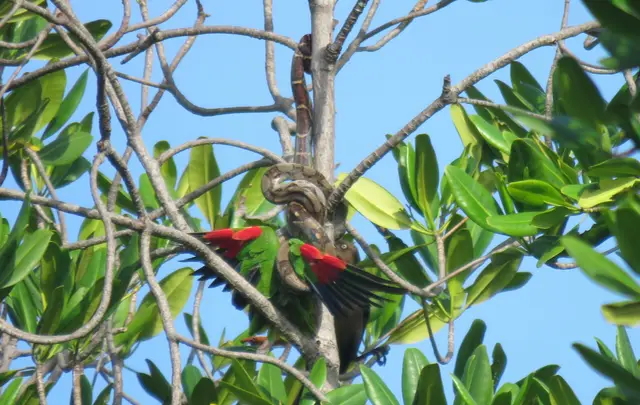
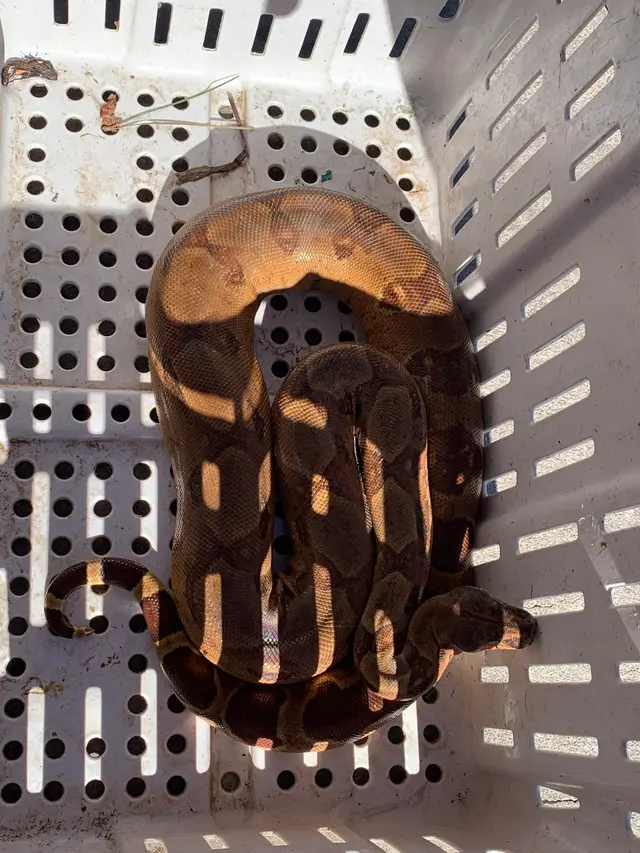
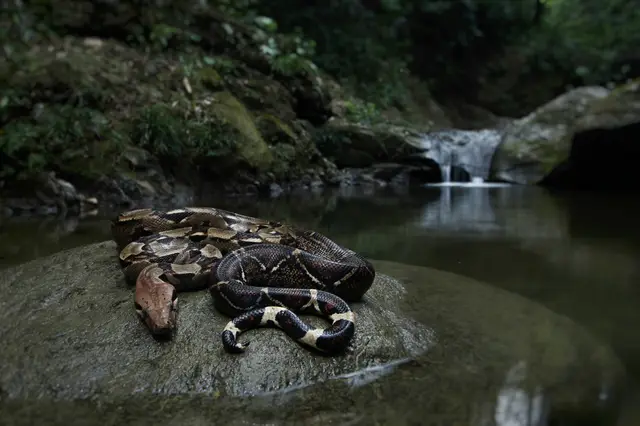
Color is not fixed. A study of island and mainland boas from Belize by Boback and Siefferman (2010) found that boas change shade over the day, turning lighter at night and darker in daylight. So the same boa can look noticeably paler at midnight than at noon.
The name comes from the islands. Cayos Cochinos means roughly "hog cays" in Spanish, and English speakers have long called them the Hog Islands. The pet trade spells it both "Hog" and "Hogg"; the two names mean the same snake.
How big do Hogg Island boas get?
Hogg Island boas are dwarfs. Females are the bigger sex, usually 5 to 6 ft (1.5-1.8 m) long in total, according to Lawlor and Brereton in Reptiles magazine (2018), compared with 7 to 10 ft for mainland females. Males are clearly smaller. Field measurements of wild snakes on both islands, summed up in the 2015 CITES case study, give these averages:
| Group | Mean snout-vent length | Mean weight |
|---|---|---|
| Females, Cayo Cochino Grande | 3.9 ft (120 cm) | 2.6 lb (1,202 g) |
| Females, Cayo Cochino Pequeno | 3.7 ft (113 cm) | 1.7 lb (759 g) |
| Males, Cayo Cochino Grande | 3.1 ft (96 cm) | 0.9 lb (399 g) |
| Males, Cayo Cochino Pequeno | 3.2 ft (99 cm) | 1 lb (434 g) |
| Newborns (one wild litter) | 1.3 ft (40 cm) | 1.6 oz (45 g) |
Snout-vent length leaves out the tail, so total length is a little longer. Females on Cayo Cochino Grande are the heaviest. The case study suggests two reasons: fewer boas on that island means less competition, and Grande has bigger prey such as agoutis and rats. A 2009 poster by Haughey and colleagues found that the size gap between the sexes is larger on Grande than on Pequeno.
Why so small? Biologists call it insular dwarfism: some large animals shrink on islands where food is limited. Boas on the other Bay Islands, such as Roatan, Utila and Guanaja, came from the same ancient spread from the mainland but did not shrink, which points to a recent drop in body size on the Cayos Cochinos.
Where do Hogg Island boas live?
Short answer: Hogg Island boas live only on the Cayos Cochinos, about 11 miles (17 km) off the town of Nueva Armenia on the north coast of Honduras. The islands belong to the Bay Islands department.
The archipelago has two main islands and about 13 small cays, with only 2.28 km2 (0.88 sq mi) of land in total. Cayo Cochino Grande covers about 1.55 km2 and has the Garifuna village of East End, a small dive resort and some holiday homes. Cayo Cochino Pequeno, at about 0.64 km2, is uninhabited apart from a research station of the Honduran Coral Reef Foundation.
Boas once lived on the small cays too. Anecdotal reports in the case study say collecting in the early 1980s wiped them out there, so today they are confirmed only on the two main islands. Nearby, the Central American boa is widespread from Mexico to Ecuador, as the Reptile Database lists. See how the range fits with other snakes on the world snake map.
Habitat
The islands are covered in oak forest (Quercus oleoides), low sea grape (Coccoloba uvifera) or a mix of both. Hogg Island boas use almost all of it, except the very dry, wind-swept forest on Cayo Cochino Pequeno. They spend more time in dense oak forest under a thick canopy, which the case study links to heat and humidity limits on these exposed islands.
That leaves less room than the map suggests. Depending on the month, only about half of Cayo Cochino Pequeno has the shade and humidity boas need. Wild boas measured at capture had an average body temperature of 27.3 C (81 F).
Behavior and temperament
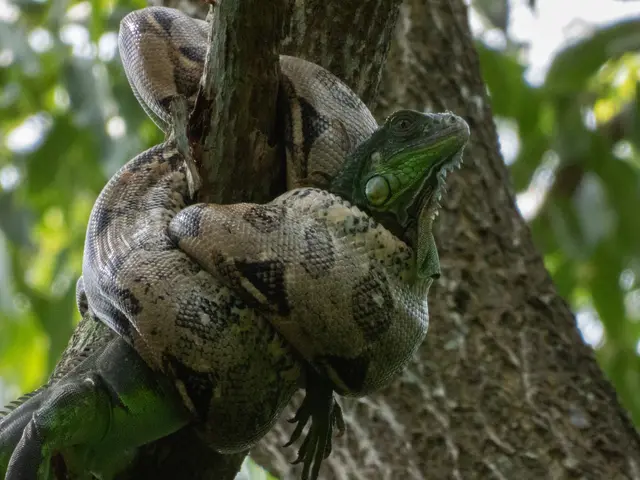
Hogg Island boas are mostly tree dwellers. They rest on branches and rely on camouflage to ambush prey that comes close, rather than hunting widely on the ground.
They are known for a calm temper. Montgomery and colleagues describe them as more docile than mainland boas, and Lawlor and Brereton report lower stress responses to handling. One likely reason is that the islands have few large predators, so the snakes have less need for a strong defense. A calm boa can still bite if grabbed or startled.
Wild boas on the islands share their home with feral cats and with dogs that residents and the research station keep for security. Both are listed as threats in the case study.
What do Hogg Island boas eat?
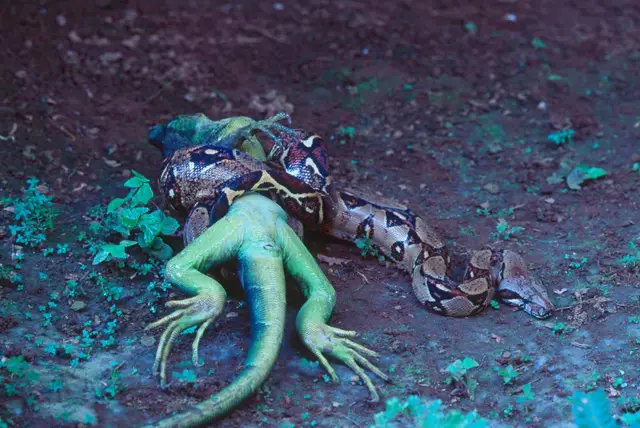
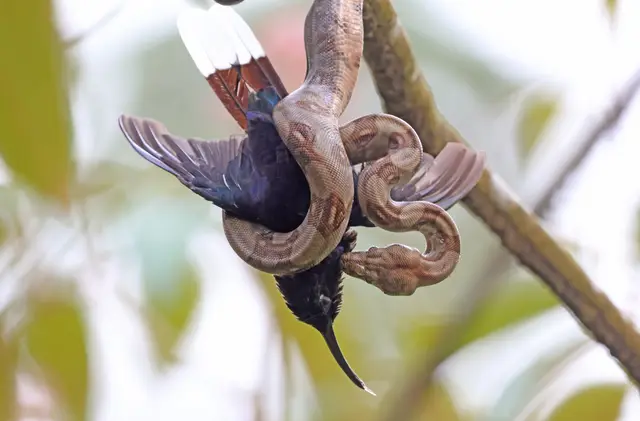
Hogg Island boas eat whatever their island offers. They are generalists that take lizards, birds and bats, and on Cayo Cochino Grande they add small to medium mammals. The two islands sit less than 1 km (0.6 mi) apart, but their menus differ a lot.
| Island | Main prey available |
|---|---|
| Cayo Cochino Pequeno | Almost only lizards and migratory birds; the island has no ground-dwelling mammals |
| Cayo Cochino Grande | Lizards and birds, plus agoutis (Dasyprocta punctata), pacas, house mice, Norway rats and nine-banded armadillos, some or all of them likely introduced |
| Both islands | Bats; Honduran spiny-tailed iguanas and green iguanas also live on both islands |
The prey lists come from the CITES case study and the Haughey poster, which also note that the mammals on Grande may all have been brought in by people.
Is the Hogg Island boa venomous?
No, the Hogg Island boa is not venomous and is not dangerous to people. It has no venom glands or fangs. It grabs prey with rows of small, backward-curved teeth and squeezes until the animal's circulation stops.
Even the biggest females weigh only a few pounds, far too small to constrict an adult person. A bite leaves a cluster of small puncture wounds that can bleed. Wash the bite with soap and water and see a doctor if it turns red or swollen over the next few days. The snakebite FAQ explains basic first aid.
The Cayos Cochinos have no dangerously venomous snakes. Of the other species recorded on the islands, a few, such as the cat-eyed snake, have small rear fangs and weak venom for frogs and lizards, but none is a medical risk to people.
Snakes confused with the Hogg Island boa
On the islands, no other snake is as thick or heavy, so a wild boa is easy to name. The confusion comes in the pet trade, where Hogg Island boas have long sold for more than ordinary boas and pale captive-bred boas look much the same.
Central American boa (mainland)
Boa imperator · Harmless
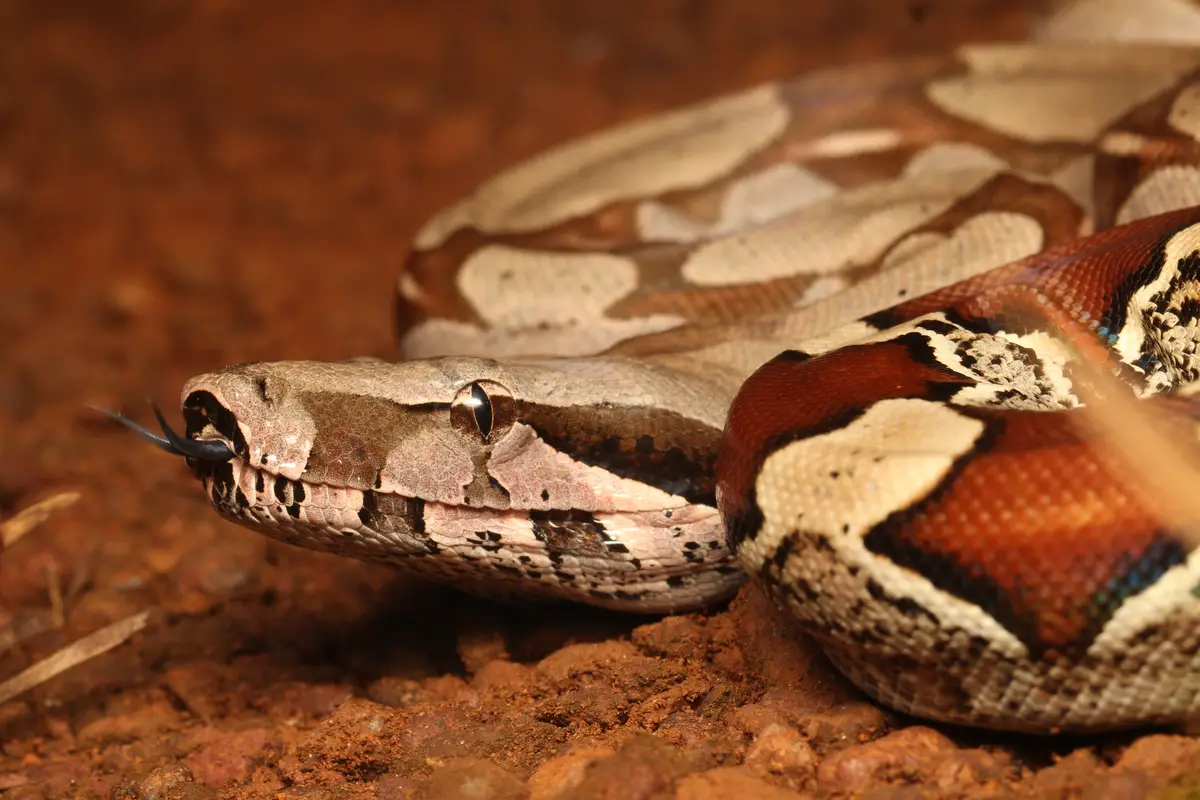
The same species from the mainland is larger, with females reaching 7-10 ft, and usually darker with stronger contrast. Smugglers in the 1980s moved island boas through Belize and sold them as mainland snakes, so origin claims in the trade are hard to check.
Boa constrictor
Boa constrictor · Harmless
The South American boa constrictor is the larger red-tailed boa of the pet trade, now usually treated as a separate species. It is darker and bulkier and does not live in Honduras.
Hypomelanistic pet boas
Boa imperator (captive bred) · Harmless
Breeders produce pale "hypo" boas from mainland stock. They can look much like Hogg Island boas but grow to mainland size. Only a known breeding history tells them apart.
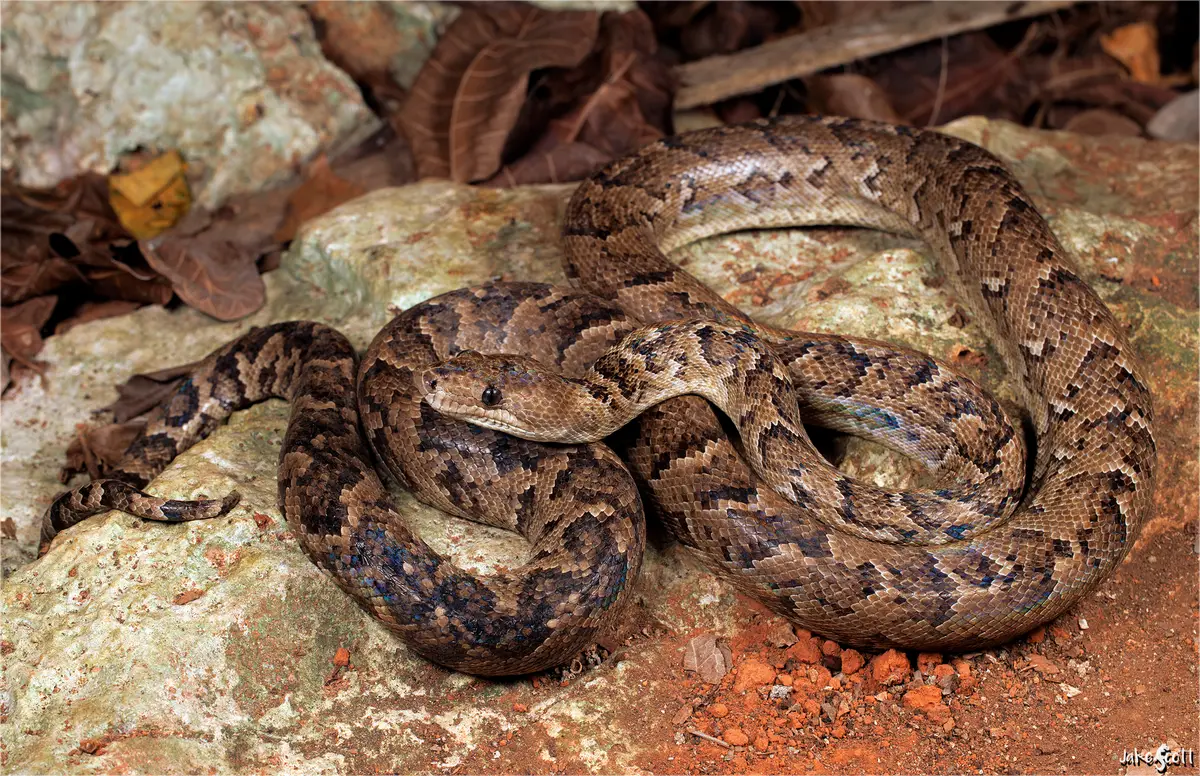
Cuban boa
Chilabothrus angulifer · Harmless
Another island boa from the Caribbean, the Cuban boa is much larger, with dark angular blotches on a tan body and heat pits along its lips. It lives only in Cuba.
Reproduction
Hogg Island boas give birth to live young, mostly in August and September. Wild data are thin. The case study reports only one wild litter, of five newborns averaging 40 cm (16 in) snout-vent length and 45 g (1.6 oz). Those babies were about the size of mainland Belize newborns and larger than babies of island boas in Belize.
Litters are probably small. Boa constrictors as a group can have up to 63 young in a litter, but dwarf island boas in Belize averaged 4.6 young, against 30 for mainland Belize females, according to Boback's 2005 study in Copeia as summarized in the case study. How often Hogg Island females breed is still unknown. A University of Texas at El Paso project led by Oceane Da Cunha set out in 2019 to fill these gaps, including whether one litter can have several fathers.
In captivity the boas breed readily. Breeders in the United States and Europe now produce them, and the case study links captive breeding to a fall in price from about US$1,000 per snake in 2005 to about US$150 in 2014.
Is the Hogg Island boa endangered?
The Hogg Island boa has no formal threat category of its own, but it is a small, isolated population that came close to disappearing. The 2015 case study notes that the IUCN had not assessed boa constrictors or their subspecies, and the island form is not a separate species. Researchers at the University of Texas at El Paso describe the population as endangered because of poaching, habitat loss, growing tourism and its tiny range.
| Measure | Status |
|---|---|
| CITES | Appendix II, like all boas |
| Honduras | Collection and export prohibited, including during the years of heavy harvest |
| Protected area | Cayos Cochinos Archipelago Natural Marine Monument, managed by the Honduran Coral Reef Foundation since about 1994 |
| Wild population | Average of 698 boas on Cayo Cochino Pequeno in 2005-2007; under 3,000 in total |
Poaching drove the decline. In the early 1980s most residents of East End collected boas as their main income. Estimates of snakes taken between 1979 and 2004 run from 5,000 to 15,000, more than 23 per hectare, and many were smuggled into Belize and exported as mainland boas. A five-day survey in the early 1990s by Wilson and Cruz Diaz found no boas at all.
Protection has helped. Mark-recapture work put the Cayo Cochino Pequeno population at an average of 698 boas from 2005 to 2007, or about 10.9 per hectare, and genetic diversity is lower than before but not alarmingly so. Poachers were still arrested in 2004, 2008 and 2010, and wild-caught snakes still turn up in the trade. Buying only captive-bred Hogg Island boas with a clear history is the simplest way keepers can help.
Hogg Island boa FAQ
Is the Hogg Island boa venomous?
No. The Hogg Island boa has no venom and no fangs. It is a constrictor that holds prey with small teeth and squeezes it. Adults weigh only about 1-3 lb, so they pose no constriction risk to people. A bite can bleed and should be washed with soap and water and watched for infection.
How big do Hogg Island boas get?
Wild females average 113-120 cm (3.7-3.9 ft) from snout to vent and usually reach 5-6 ft (1.5-1.8 m) in total length. Males are smaller, averaging 96-99 cm (about 3.2 ft) snout to vent. Mainland Central American boa females often reach 7-10 ft, so the island boas are clear dwarfs.
Why are Hogg Island boas pale?
Hogg Island boas have reduced dark pigment, a look keepers call hypomelanistic, which gives them a light gray or pinkish body. Like other boas they also change shade over the day; a study of Belize boas by Boback and Siefferman (2010) found they turn lighter at night and darker in daylight.
Is the Hogg Island boa a separate species?
No. The Hogg Island boa is an island population of the Central American boa, Boa imperator, once called Boa constrictor imperator. Genetic work summarized in the 2015 CITES case study found it is not distinct enough to be a subspecies, but it should be managed as an evolutionarily significant unit.
Are Hogg Island boas endangered?
The population has no IUCN category of its own, but it is small and vulnerable. Fewer than 3,000 boas are thought to live on the two Cayos Cochinos islands. Poaching for the pet trade removed an estimated 5,000 to 15,000 snakes between 1979 and 2004, and Honduras bans collection and export.
Where do Hogg Island boas come from?
They come only from the Cayos Cochinos, also called the Hog Islands, about 11 miles (17 km) off the north coast of Honduras. Wild boas live on Cayo Cochino Grande and Cayo Cochino Pequeno, which together with small cays have about 0.9 sq mi of land.
Related snakes
Sources
- Montgomery, Boback, Reed and Frazier (2015), Cayos Cochinos boa, CITES pet trade case study
- USGS: An assessment of the impact of the pet trade on five CITES-Appendix II case studies
- Reptile Database: Boa imperator
- Boback and Siefferman (2010), Variation in color and color change in island and mainland boas, Journal of Herpetology
- Haughey et al. (2009), Body size and condition of Boa constrictor imperator on the Cayos Cochinos, SICB
- Da Cunha (2019), Filling the life history of the Hog Islands boa, University of Texas at El Paso
- Lawlor and Brereton (2018), Hog Island boa constrictors, Reptiles magazine
- iNaturalist: Boa imperator observations